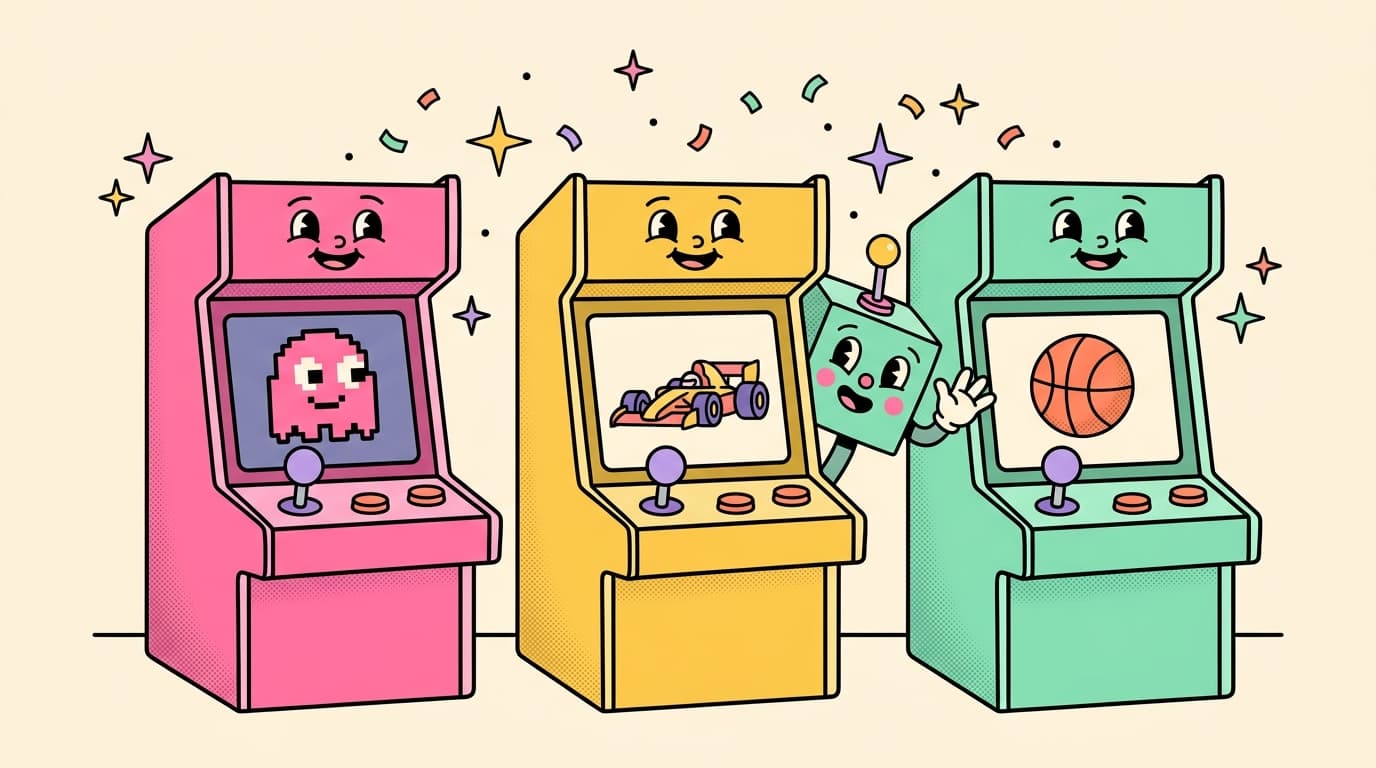
We get the question a lot: "What's actually on the floor?" Fair question. A 2026 arcade isn't the floor of pinball cabinets and quarter buckets you remember from 1992 — but it's also not a screens-only "interactive entertainment center." We've leaned into the middle: 19 cabinets across 5 categories, mostly restored originals, with a couple of licensed reproductions where the originals don't survive a kid's birthday party. Here's a walking tour.
✦ The short answer
University Arcade has 19 working cabinets at our U-District location: 4 arcade classics (Pac-Man, Galaga, Donkey Kong, Centipede), 4 racing cabinets, 3 multiplayer beat-em-ups, 6 redemption (Skee-Ball, claw, Whac-A-Mole, etc.), and 2 jumbo claw machines. Approximately 70% are restored original cabinets sourced regionally; the rest are licensed reproductions.
Why classic cabinets are different
The cabinet matters. A 1981 Pac-Man stand-up cabinet in working condition has a feel — the joystick weight, the button click, the cathode-ray flicker — that a flat-screen Pac-Man emulator doesn't. Kids notice it even if they can't articulate it.
We've focused on three things across the floor:
- Working originals where possible. Cabinets restored from collectors and estates around the Pacific Northwest, with new monitors where the original CRTs couldn't be saved. The hand-feel is intact.
- Licensed reproductions where the originals are too rare or fragile. Mario Kart Arcade GP and the modern multiplayer cabinets are reproductions, and that's the right call — they need to survive thousands of kid hours per year.
- Reliability. Every cabinet on our floor gets serviced weekly. A cabinet that's 70% working 70% of the time is worse than no cabinet. We'd rather have 19 cabinets that all work than 25 cabinets where 6 are out.
The 5 categories on our floor
Every cabinet falls into one of these:
| Category | Count | Best for ages | Vibe |
|---|---|---|---|
| Arcade Classics | 4 | 6–12 | Retro, single-player, focused |
| Racing | 4 | 7–12 | Seated, multiplayer, kinetic |
| Multiplayer Beat-em-up | 3 | 8–12 | 2–4 player, button-mashy |
| Redemption | 6 | 4–12 | Tickets, prizes, all ages |
| Crane & Plush | 2 | 4–12 | Pure dopamine, all ages |
Below: every cabinet, what it's good for, and a note from us.
Arcade Classics (4)
These are the ones the parents recognize.
Pac-Man (1981 original cabinet, restored). The single most iconic arcade game ever made. Kids who've never seen it figure it out in 90 seconds. Strong fit for ages 6–12. Single-player only — they take turns naturally.
Galaga (1981, restored). Vertical-scrolling space shooter. The capture-and-rescue mechanic is the surprise hook — kids love getting their second ship. Ages 7+.
Donkey Kong (1981, restored). The original Mario before he was Mario. Harder than Pac-Man; the kids who lock onto it stay for an hour. Best for ages 8+.
Centipede (1981 restored, with original trackball). The trackball is the magic. Kids this generation have never used one, and the tactile feedback is a small revelation. Ages 6+.
Racing (4)
The seated cabinets — kids fight over these.
Daytona USA (1994 cabinet, restored, networked 2-player). The deep cut. Older kids (10+) appreciate the seat and the steering wheel. The cabinet sound is loud and the kids love that.
Cruisn USA (1994, original). The somewhat goofier American cousin to Daytona. Highway-themed, easier to play, broader age appeal. Ages 7+.
OutRun (1986 cabinet, restored). The pioneer of arcade racing. The music alone is worth a stop. Ages 8+.
Mario Kart Arcade GP (modern licensed reproduction, 4-player). The cornerstone of any kid party. 4-player networked karts, characters they recognize, races short enough to cycle through 8 kids in 20 minutes. Ages 6–12.
For why Mario Kart specifically lands at 7- and 8-year-old parties, see our age-specific guide.
Multiplayer Beat-em-ups (3)
Two- to four-player simultaneous co-op cabinets. These are where 4 kids will shoulder up to one machine.
NBA Jam (1993 cabinet, restored, 4-player). "He's on fire!" The single most consistently popular cabinet for kids 9–12. The cabinet has 4 panels of buttons, and 4 kids playing it simultaneously is a moment. Ages 8+.
Teenage Mutant Ninja Turtles Arcade (1989, restored, 4-player). A 1989 beat-em-up with all four turtles playable. Older kids (10+) appreciate the nostalgia/cool factor; younger kids (6–9) just like punching things in Splinter's name. Ages 7+.
X-Men Arcade (1992, 4-player). Same model as TMNT but X-Men flavored. The 6-player version of this cabinet is rare; we have the 4-player. Solid for ages 8+.
Redemption (6)
The "you win tickets" cabinets — popular at every age.
Skee-Ball (3 lanes). The classic. We have three lanes so 3 kids can roll simultaneously. Universal appeal — works at 4, works at 12. The most-played cabinet on the floor by total time.
Whac-A-Mole (2 cabinets). Two stations so two kids can play side-by-side. Pure physical satisfaction. Ages 4+.
Pop-A-Shot (basketball mini-shoot). Real mini-basketballs into real mini-hoops. Time-pressure scoring. Ages 6+.
Connect 4 Hoops. Connect-four meets basketball — sink the ball into your column. Surprisingly strategic. Ages 7+.
Big Bass Wheel. Pull the lever, the giant wheel spins, the kid screams. Pure showmanship. Ages 4+.
Stacker Jr. The forgiving kids' version of the classic Stacker. Stack the moving lights to win the prize. Ages 5+.
The redemption tickets aggregate into prizes available at the host counter — toys, candy, plushes. Tickets are included in our party packages.
Crane & Plush (2)
The claw machines. We have two:
Classic Claw. Standard mid-size claw, plushes and toys. The "is the claw rigged?" question kids always ask — we keep ours generously calibrated, because the experience of winning on the claw is the whole point.
Jumbo Claw. Bigger plushes, longer arm. Kid wins a 24" plush, kid is the hero of the party. Lower win rate than the classic, but the prize is the photo of the day.
How we picked these 19
A few principles guided the selection:
- Spread of categories, so kids of different temperaments find their cabinet fast. The shy kid drifts to Stacker Jr; the kinetic kid goes to Whac-A-Mole; the strategist locks onto Connect 4 Hoops.
- Age range coverage 4–12, with some cabinets that work the full range and some that target a sub-band.
- Multiplayer presence — at least 3 cabinets where 4 kids can play simultaneously, so a party doesn't bottleneck.
- Original cabinet bias — about 70% of the 19 are restored originals, which the older kids and parents notice.
- Reliability — we've turned down a few storied cabinets that we couldn't keep working at the standard we want.
Visiting
The floor lives at 4209 University Way NE, between NE 42nd and NE 43rd. We're by-reservation only — every visit is a booked party, and during your booked window the floor is yours, no other guests, no waiting in line for cabinets, no quarters.
For the full rundown of how a party works, see our parties page or the pillar guide.
"My 9-year-old played Galaga for an entire hour. He'd never seen it before. I'd never seen him sit still that long."
Are the cabinets actually originals?
About 70% are restored original cabinets, mostly sourced from Pacific Northwest collectors and estates. The remaining 30% are licensed reproductions — happy to point out which are which on a tour. The Mario Kart Arcade GP cabinet is a modern licensed cabinet because the original is too rare to run as a kid-party machine.
Do the cabinets take quarters?
No. Everything's included in the party package — no fumbling for tokens, no kids running out of credits, no parent banking machine.
Will the cabinet selection change?
The core 19 are stable. We rotate occasional guest cabinets (typically 1–2 at a time) when we find an interesting restoration project. The named cabinets above are the permanent floor.
✦ ready to reserve?
Book Your Party Slot
4209 University Way NE · By reservation only · 10am–8pm